Paste a YouTube link.
Check brand fit on any creator.
Paste a YouTube channel and instantly see if it's a good fit for your brand — including audience match, brand alignment, and sponsorship value.
✔ Check brand fit before you spend money
Try it now: ••
💡 e.g. "Does this gaming creator fit with Feastables?"
Drop the link — that's it
Paste any YouTube channel URL. SparkLine pulls live subscriber counts, engagement rates, content mix, and posting cadence in real time. No spreadsheets. No manual research.
Five scoring dimensions, zero guesswork
SparkLine runs the full S.P.A.R.K. framework — Strategic Storytelling, Partnership Alignment, Authentic Engagement, Reach Amplification, and Key Differentiation — scored against your brand. Every number is live data, not an estimate.
Walk in ready to close the deal
A complete PDF lands in your inbox: SPARK scores, true sponsorship pricing, matching factors, and a full AI-generated campaign strategy — ready to send before anyone else does.
Turn any YouTube channel into a brand deal pipeline.
SponsorMatch™ analyzes a creator's channel and surfaces 12 perfectly-matched brands — complete with real contact emails scraped from their websites, fit scores, deal range estimates, and LinkedIn outreach tips.
Exclusive to Agency Pro subscribers
Paste a YouTube URL
Drop any creator's channel link and SponsorMatch™ pulls their live stats — subscribers, engagement, niche, and recent content.
12 Ranked Brand Matches
AI surfaces 12 brands with a documented history of sponsoring similar creators — ranked by fit score from 1–100.
Real Emails from Brand Sites
For each match, SponsorMatch™ crawls the brand's website to extract real contact emails — not AI-guessed ones.
Deal Range Estimates
Sponsorship history, estimated deal ranges, and one-click SPARK analysis for every brand–creator pair.
See It In Action
Paste a link. Get this
in 60 seconds.
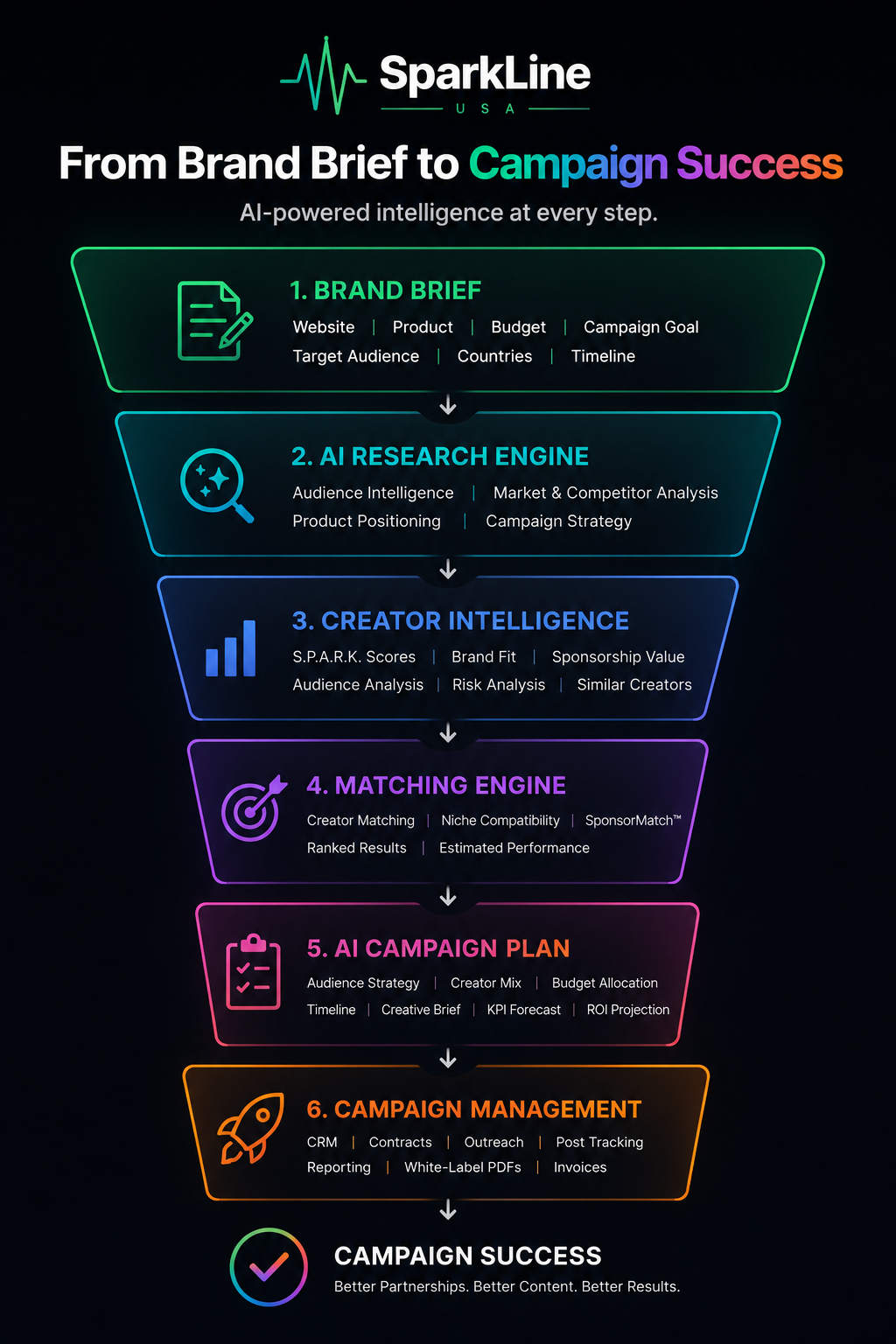
SPARK score, brand safety audit, creator matches, and a full PDF report — all from a single YouTube URL.
Creator Finder + SponsorMatch™
Don't know which creators to analyze yet?
SparkLine scans 100,000+ creators, ranks them by niche alignment and SPARK score, then runs SponsorMatch™ to show you exactly which brands each creator converts best for.
What Makes SparkLine Different
Focused. Proprietary. Accurate.
Three design decisions competitors haven't made — and why they matter for your ROI.
Not spread thin across 12 platforms
YouTube-Only. By Design.
Modash, Heepsy, and Upfluence cover Instagram, TikTok, YouTube, and more — which means they cover none of them deeply. SparkLine goes all-in on YouTube: per-video CPV, posting cadence analysis, brand safety scoring, audience quality grades, and content style signals that simply don't exist on other platforms.
5 dimensions vs. a single engagement rate
SPARK Is a Framework, Not a Metric
Most tools hand you a follower count and call it analysis. S.P.A.R.K. evaluates Strategic Storytelling, Partnership Alignment, Authentic Engagement, Reach Amplification, and Key Differentiation — each scored against your specific brand, not against generic benchmarks. The result is a brand-fit score, not a popularity score.
Per-video CPV model, not industry averages
Pricing That Reflects Reality
Industry rate cards are guesses. SparkLine's Pricing Engine analyzes a creator's actual recent video performance — median view counts, audience retention, and niche CPM data — then models conservative, expected, and optimistic CPV scenarios so you negotiate with real numbers instead of gut feel.
How We Compare
Why SparkLine beats Modash,
Heepsy, and Upfluence
| Feature | SparkLine | Modash | Heepsy | Upfluence |
|---|---|---|---|---|
| YouTube-native intelligence (CPV, cadence, brand safety) | ✓ | — | — | — |
| 5-dimension SPARK brand-fit scoring | ✓ | — | — | — |
| Pricing engine with CPV scenarios (not rate cards) | ✓ | — | — | — |
| AI campaign plan generator | ✓ | — | — | ~ |
| Video-level performance tracking | ✓ | ~ | — | ~ |
| First analysis free — no credit card | ✓ | — | — | — |
| Verified creator contact emails | ✓ | ✓ | ✓ | ✓ |
| Multi-platform coverage (Instagram, TikTok…) | — | ✓ | ✓ | ✓ |
Trusted by brands & creators
Case Studies
Real results from real campaigns
YouTube subscriber growth in 4 weeks
Launched a new product line to a YouTube audience they didn't have yet.
Micro-Mark was launching Micro-Mark Paint — a new USA-made acrylic paint line created to fill a real market deficit for domestic hobbyist paints. SparkLine's Video Analyzer identified exactly which YouTube creators were producing high-performing paint and miniature content, and surfaced paid amplification opportunities timed to the launch. In four weeks, their subscriber count grew 599× as the right creators reached the right audience at the right moment.
increase in organic creator-driven traffic
Reached gaming YouTubers that were out of reach — without a mega budget.
AndaSeat needed to grow creator-led organic traffic in a market dominated by brands with massive influencer budgets. SparkLine's matching engine identified mid-tier gaming creators with highly engaged audiences — channels that drove real purchase intent but hadn't yet been locked up by competitors. The result was a 3.2× lift in creator-driven organic traffic at a fraction of traditional influencer spend.
brand sponsorship deals closed in 90 days
Turned a 212K-subscriber channel into a consistent brand deal pipeline.
TrickGMD — a gaming content creator and top-ranked GD player with 212K subscribers — was producing high-quality content but struggling to connect with brands willing to sponsor it. SparkLine identified brand categories aligned with his audience, built a positioning brief around his engagement data and niche authority, and helped him close 12 sponsorship deals in 90 days across gaming peripherals, energy drinks, and mobile gaming brands.
Platform Capabilities
Everything you need to run
data-driven creator campaigns.
Creator Intelligence
AI-powered SPARK scoring across 5 dimensions — Strategic Storytelling, Partnership Alignment, Authentic Engagement, Reach Amplification, and Key Differentiation.
Matching Engine 2.0
Match brands to creators using 6 weighted factors: niche alignment, engagement quality, reach scale, growth momentum, content style, and consistency.
Pricing Engine
Get data-driven fee estimates, CPV projections across conservative/expected/optimistic scenarios, and a suggested campaign budget — before you negotiate.
Campaign Plan Generator
GPT-4o-mini builds a complete, actionable campaign strategy tailored to your brand goals, budget, and creator profile — delivered instantly.
Post Tracking
Track any YouTube video's live performance — brand safety scoring, audience quality grades, amplification velocity, and flagged content keywords.
Your first creator analysis
is free.
Paste a YouTube channel. Get a SPARK score, real pricing, and a campaign brief — in under 60 seconds.
Analyze a Creator NowNo account needed · No credit card · Results in 60 seconds